
Luce County Arrest Warrants Explained
In Luce County, an arrest warrant starts with a sworn complaint. A magistrate or judge reviews it and decides whether reasonable cause exists. If the answer is yes, the judicial officer signs the order. Michigan law requires that signature. The warrant names the accusation, directs a peace officer to arrest the person, and requires that the person be brought before a judicial officer without unnecessary delay. None of that settles the case. It only marks the point where the court found enough cause to authorize an arrest, which is a different question from what a trial or plea later decides. A bench warrant works differently, because it answers a missed court obligation rather than a new accusation.
From Luce County Complaint to Signed Warrant
The path from complaint to signed warrant in Luce County is short but specific. A complaint gets filed, and the facts are presented under oath. A judicial officer then weighs whether reasonable cause exists. If it does, the warrant is signed and entered in the case file; if the court prefers, a summons can issue instead.
Process line: Complaint › Sworn facts › Reasonable-cause finding › Warrant signed › Entry in the case file › Service and arraignment.
Michigan Court Rule 6.102 and MCL 764.1b set out what a Luce County warrant must contain and what it commands. The state statute on warrant contents spells out the arrest command and the return to the court.
Inside a Luce County Arrest Warrant
A Luce County arrest warrant, plus the case file behind it, lists identity details, the charge, and service entries. How much of that is public varies with the case type. The pattern that follows is only the shape of a Michigan case number, not a real record.
| Case or Warrant Number | Styled roughly like 92D-2024-00451 |
|---|---|
| Accused Identity | Name or identifying description, plus the identifiers the warrant form lists |
| Offense and Statute | The charge and the section it comes from |
| Issuing Court and Judge | The court that signed the order and the judicial officer's signature |
| Interim Bail | An amount or condition if the court stated one in the warrant |
| Command and Return | The arrest command, plus the officer's record of execution or attempted execution |
The Officers Who Execute a Luce County Warrant
Only a peace officer or another authorized person may execute a warrant. In practice that can mean the Luce County Sheriff's Department, the Michigan State Police, or another agency with jurisdiction. The county names no dedicated warrant squad and posts no live service roster. To reach the right office, work through the court listings; the Luce County directory gathers the court administrator and magistrate, the district judge, the deputy clerk, and community courts contacts in one place.
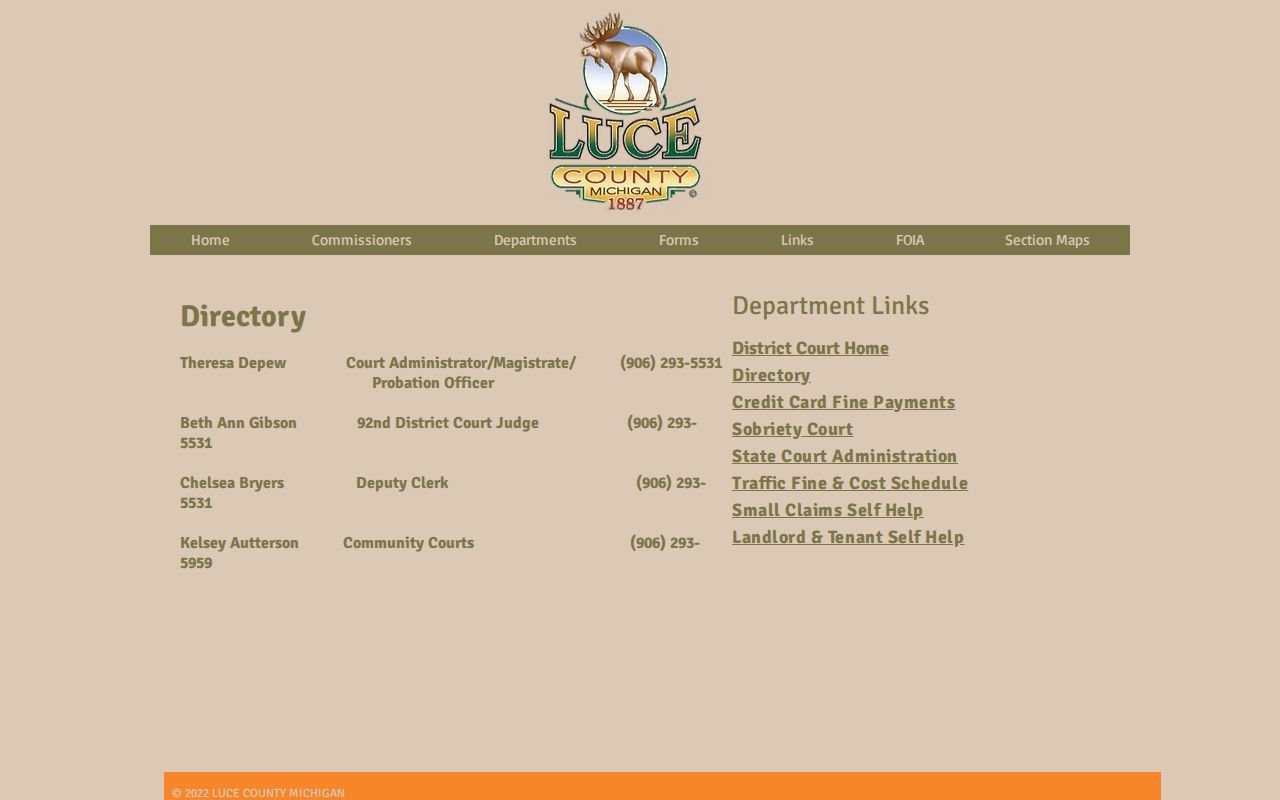
Use the Luce County directory to reach the office that holds the file, not to check a warrant's status.
Serving Luce County Arrest Warrants
Serving a Luce County warrant usually means an arrest, booking, and an appearance before a judicial officer. Sometimes the news arrives at a traffic stop instead. That is how an old order can surface at an unexpected moment. Under Michigan law, an officer may arrest on a Luce County warrant based on positive information from a court or another peace officer. The paper itself does not have to be in hand, only verified. Before assuming how a surrender would work, ask the issuing court about interim bail and the appearance route. Note: No walk-in surrender window is published for the Luce County Sheriff's administrative office, so call before going there.
When a Summons Replaces a Luce County Arrest Warrant
Michigan changed its default approach in recent years. The 2020 jail-reform changes pushed courts toward summonses and voluntary appearances in situations that once moved straight to arrest. A charge in Luce County can therefore begin with a mailed order to appear rather than a warrant. Arrest warrants have not gone away. A court may still issue one when the grounds exist, including assaultive or domestic-violence concerns, a reason to think the person will not appear, safety worries, or a prosecutor's request. A charge alone never tells you whether a warrant exists. Only the Luce County court file does.
Comparing Luce County Arrest, Summons, and Bench Warrants
Three orders look similar on paper and behave differently in practice.
| Instrument | What It Does | What Happens Next |
|---|---|---|
| Arrest warrant | Commands an officer to arrest and bring the person before a judicial officer | Arrest, booking, and arraignment |
| Summons | Orders an appearance without authorizing immediate arrest | A scheduled court date |
| Bench warrant | Responds to a missed date or a violated condition | Voluntary appearance, recall, or arrest |
State and Federal Warrants in Luce County Cases
Luce County sits in the Northern Division of the Western District of Michigan. That matters when a warrant crosses lines. A state warrant from the 92nd District Court or the 11th Circuit Court stays on the county docket. A federal warrant runs through the federal clerk instead. The federal court location serving the area sits in Marquette. So a Luce County case search will not surface a federal warrant. A federal docket may not show a sealed filing either. If a federal agency is involved, call the federal clerk or talk with an attorney rather than digging through county records.
If There's a Luce County Arrest Warrant for You
Get the facts first. Confirm the court, the case number, and the charge. Then talk to a licensed Michigan attorney about your options. Those include a voluntary appearance, a scheduled surrender, posting bond, and asking the court to recall the Luce County warrant. No amnesty or walk-through program exists here, so build your plan with counsel.
- Call the issuing court and confirm that a warrant is on file and which case it belongs to.
- Ask whether the court accepts a voluntary appearance and what identification to bring.
- Ask what bond or release terms apply, since no county schedule is published.
- Speak with an attorney before turning yourself in or paying anything.
- Call the sheriff's office before any surrender to confirm the current procedure and location.
Important: Do not ignore an arrest warrant. Being stopped with one active can lead to arrest away from home, at a worse time.
Voluntary Appearance in a Luce County Warrant Case
Michigan Court Rule 6.105 offers a person named on an arrest or bench warrant a way to walk into the issuing court on his own, and it generally works within one year of the warrant. Once the person presents himself, the court has choices. If a judge is available, the arraignment happens within two hours. Otherwise the court recalls the warrant and schedules the appearance for another day. There are exceptions, though. Assaultive charges, domestic-violence cases, and a record of repeated failures to appear all fall outside the rule's ordinary treatment, so the Luce County court handles those differently. Call ahead and ask what the Luce County court expects before anyone shows up, since some appearances can be set up through counsel while others require the person himself. The rule opens a door to a court date. It does not promise release.
What the Luce County Warrant Record Shows
A public docket has limits. It can confirm that a charge was filed and that a warrant event took place, nothing more. Investigative files and affidavits stay sealed off from public view. Law-enforcement entries do too. Search-warrant affidavits follow their own rule and open up only on the fifty-sixth day. When you contact the Luce County clerk, name the exact paper you want, whether that is a docket entry, a warrant order, or a recall order. The county clerk page posts the office phone along with the court-section fee table, so a certified copy's cost is clear before you make the request.

That page also shows what a certified copy costs before you ask.